


What Is DTF Printing and How Is It Used for Custom Apparel?

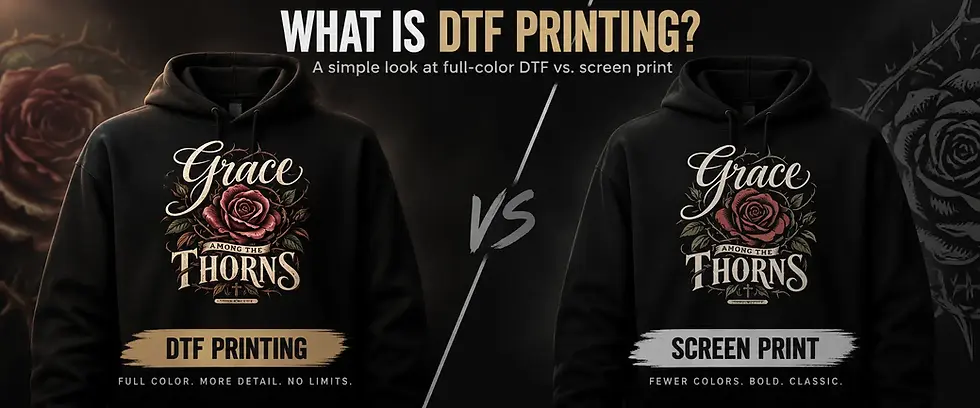
If you have looked into custom T-shirt printing recently, there is a good chance you have seen the term DTF printing. It has become an important method for producing everything from one custom shirt to detailed business apparel, church shirts, event merchandise, photo shirts, and larger group orders.
But what is DTF printing and how is it used for custom apparel?
DTF stands for direct-to-film printing. Instead of printing a completed design directly onto the garment, the artwork is first digitally printed onto specialized transfer film. An adhesive is applied to the printed transfer, the transfer is prepared or cured, and heat and pressure are then used to bond the design to a compatible garment.
That process makes DTF especially useful for detailed, full-color designs, photographs, gradients, illustrations, logos, lettering, and artwork containing many colors.
It is also flexible when it comes to order size. DTF can make sense for a single custom shirt, a small family order, business apparel, church shirts, team apparel, event merchandise, or a larger bulk project.
The final result still depends on much more than the printing method itself. Artwork quality, the garment, the transfer, application settings, materials, and proper care all matter.
At K&M Kustom Kreations in Joplin, Missouri, DTF is one of the primary methods we use for custom apparel because it fits many of the projects our customers bring to us.
If you are ready to turn an idea into apparel, learn more about our Custom T-Shirt Printing Services in Joplin, Missouri.
What does DTF stand for?
DTF stands for direct-to-film.
The name describes the basic process. The design is printed onto a special transfer film first instead of being printed directly onto the shirt.
The completed transfer is then applied to the garment with heat and pressure.
Manufacturers such as Epson, Mimaki, and Roland DG describe DTF workflows using this same basic film, adhesive, and heat-transfer process.
How does DTF printing work?
Although individual equipment and transfer systems can have different instructions, a
typical DTF process looks like this:
Artwork is prepared digitally at the intended print size.
The design is printed in reverse onto specialized DTF transfer film.
Color inks and a white layer are used where required by the system and artwork.
A compatible hot-melt adhesive powder or adhesive process is applied to the printed transfer.
The adhesive and printed transfer are cured or prepared according to the transfer system.
The garment is positioned on a heat press.
The transfer is placed on the garment and applied using the required combination of heat, pressure, and time.
The carrier film is removed according to the transfer instructions.
Some systems call for a finishing press to improve the final bond, feel, or wash performance.
Epson's current DTFilm workflow, for example, prints color and white onto specialty film, applies adhesive powder while the ink is wet, cures the transfer, and then heat-applies it to fabric. Mimaki and Roland DG document similar workflows.
The important thing for a customer to understand is that DTF is not simply a sticker being placed on a shirt. It is a controlled garment-decoration process involving properly prepared artwork, specialized film, inks, adhesive, heat, pressure, and correct application.
What types of apparel can be printed with DTF?
DTF can be used with many common apparel and fabric products, including:
T-shirts
Long-sleeve shirts
Hoodies
Sweatshirts
Some jackets
Sportswear
Some bags and totes
Some performance garments
Other compatible fabric items
Manufacturer documentation supports use across cotton, polyester, blends, denim, nylon, rayon, and other fabrics depending on the particular transfer system.
That does not mean every garment is automatically a good DTF candidate.
Fabric coatings, seams, pockets, zippers, stretch, texture, moisture-resistant finishes, garment construction, and heat sensitivity can all affect whether a particular item should be pressed.
Unusual or specialty garments should be reviewed before production rather than assuming they can be printed the same way as a standard cotton T-shirt.
Can DTF be used on cotton shirts?
Yes.
DTF is commonly used on cotton shirts and other cotton garments.
Cotton provides a suitable surface for many DTF transfer systems, which is one reason the process is commonly used for custom T-shirts.
Garment construction still matters. A smooth, quality shirt can behave differently from a heavily textured, extremely lightweight, or specialty-treated garment.
The transfer system and garment should always be matched appropriately.
Can DTF be used on polyester shirts?
Yes.
DTF can be used on many polyester shirts, blends, and performance garments.
Polyester does require more care than simply saying, "Press it like cotton."
Some polyester dyes can migrate when exposed to heat. Dye migration occurs when color from the garment moves into the transferred design, potentially changing its appearance.
Roland DG specifically warns that colored polyester can experience dye migration and recommends testing because different fabrics and dyes can react differently to temperature.
Some polyester garments can also react to excessive heat by developing press marks, discoloration, gloss, or other changes.
For that reason, the correct transfer, garment, temperature, pressure, and time need to be considered together. A setting that works for one transfer system should not automatically be treated as the correct setting for every polyester shirt.
Can DTF print full-color designs?
Yes. One of DTF printing's biggest strengths is its ability to reproduce multicolor digital artwork without preparing a separate physical screen for every individual color.
That makes DTF useful for artwork containing:
Multiple colors
Gradients
Shading
Fine lines
Small lettering
Detailed illustrations
Complex graphics
Colorful logos
Professional DTF systems commonly use CMYK color plus white ink. White can be used as an underbase so colors remain visible and opaque when transferred to dark or colored garments. Roland DG specifically documents white-underbase generation as part of its DTF workflow.
Full-color capability does not mean every digital color will automatically reproduce exactly as it appears on every phone or computer monitor.
File quality, color management, inks, printer settings, garment color, white-underbase setup, transfer materials, and production conditions can all influence the finished appearance.
Can DTF print photographs and detailed artwork?
Yes. DTF is often well suited for photographs and detailed artwork.
It is commonly used for designs containing photographic elements, gradients, shadows, fine details, small text, illustrations, and complex color transitions.
However, the printing method cannot replace information that is missing from a poor-quality original image.
A photograph that is sharp, properly exposed, and large enough for its intended print size will generally provide more usable information than a tiny screenshot, heavily compressed image, blurry photograph, or image downloaded from social media.
Important artwork considerations include:
Image resolution
Final print dimensions
Sharpness
Contrast
Lighting
Compression
Background quality
Edge quality
Original image size
Color preparation
Vector artwork is especially useful for logos, lettering, and illustrations because it can often be resized without the same resolution loss that affects raster photographs. Raster artwork can also print very well when it contains enough usable image data at the final size.
Modern DTF workflow software supports both raster and vector-oriented preparation, white-layer generation, transparent artwork, sizing, color controls, and other print-preparation functions.
At K&M, customer artwork is reviewed before production. Some files may already be ready to use. Others may need preparation, and some may require additional paid design work.
We do not promise that every photograph, screenshot, or low-resolution file can be restored or made print-ready.
Is DTF good for small custom shirt orders?
Yes.
DTF is often very practical for one shirt and small custom orders.
Traditional screen printing requires physical screen preparation. Depending on the artwork, multiple colors can also mean multiple screens and color separations.
That setup can make extremely small screen-printing jobs less practical.
DTF does not require building a separate physical screen for each artwork color, which gives it an advantage for one-off and short-run jobs, particularly when the artwork contains several colors or substantial detail. Printing industry resources identify short runs, individual pieces, full-color artwork, and detailed graphics as common DTF use cases.
K&M accepts single custom-shirt orders as well as small orders.
That does not mean every one-shirt order costs the same. Pricing can depend on the garment, artwork, print dimensions, placement, design preparation, quantity, and other production requirements.
You can learn more about those factors in our Understanding Custom Shirt Pricing guide.
Can DTF be used for bulk custom shirt orders?
Yes.
DTF is not limited to one-off shirts or tiny orders.
It can also be used for larger custom apparel projects, particularly when the artwork contains many colors, photographs, gradients, fine details, complex graphics, or personalization.
For example, a church may need a large order using a detailed multicolor ministry design. A business may need shirts in several sizes. An event may need full-color artwork that would require more complicated color separation with traditional screen printing.
DTF can remain a practical production option in situations like these.
That does not mean DTF is automatically the best process for every bulk order.
A very large quantity of identical shirts using a simple one-color or limited-color design may be an excellent candidate for screen printing.
The correct choice depends on the complete project, including artwork, quantity, garment, personalization, deadline, and production requirements.
K&M works with group and bulk orders through our Bulk Order Services.
How is DTF different from screen printing?
The biggest difference is how the artwork reaches the garment.
DTF printing digitally prints the design onto transfer film. That transfer is then bonded to the garment using heat and pressure.
Traditional screen printing pushes ink through prepared mesh screens directly onto the garment.
For multicolor screen printing, the artwork is generally separated by color and individual screens are prepared and aligned. DTF does not require creating a physical screen for every color in the artwork.
This makes DTF flexible for detailed full-color designs, photographs, gradients, smaller quantities, and projects that change frequently.
Screen printing still has important strengths. For large repeated orders using simple designs and a limited number of colors, it can be highly efficient.
Neither method is automatically better for every project.
For a deeper comparison, read DTF Printing vs. Screen Printing: Which Is Better for Custom Shirts?
What affects DTF print quality?
DTF print quality comes from the entire production chain, not one single machine or material.
Important factors include:
Original artwork quality
Image resolution
Final artwork dimensions
Design preparation
White-underbase preparation
Printer condition and calibration
Ink quality
Transfer-film quality
Adhesive quality and application
Proper curing
Garment fabric and texture
Correct heat
Correct pressure
Correct pressing time
Transfer placement
Peel procedure
Finishing procedure
Production experience
Customer care after printing
Even high-quality equipment cannot fully correct poor source artwork or an incorrect transfer process.
Likewise, excellent artwork can still produce a poor result if the transfer is under-cured, over-cured, pressed at the wrong temperature, applied with uneven pressure, or used on an unsuitable garment.
Professional DTF manufacturers place significant emphasis on ink delivery, white-ink consistency, temperature management, material compatibility, and correct file setup because each one contributes to repeatable output.
How durable is DTF printing?
DTF can produce durable custom apparel when quality materials are used, the transfer is correctly prepared and applied, the garment is compatible, and the finished item is cared for properly.
There is no responsible universal wash-count number that applies to every DTF shirt.
Durability can be affected by:
Transfer quality
Adhesive quality
Proper curing
Application temperature
Pressure
Application time
Garment fabric
Fabric stretch
Print size
Frequency of wear
Washing temperature
Detergents and bleach
Drying temperature
Repeated heat exposure
General garment care
This is why K&M does not use a blanket promise such as "every DTF print lasts X washes."
Different transfer systems, garments, artwork, and laundry habits create different real-world conditions.
The better goal is proper production combined with proper care.
How should DTF-printed shirts be washed and cared for?
A few simple habits can help protect both the garment and the print.
For general care:
Turn the garment inside out before washing.
Use cold or cool water.
Use a mild laundry detergent.
Avoid chlorine bleach.
Avoid unnecessarily high heat when drying.
Hang drying or lower dryer temperatures can reduce repeated heat exposure when the garment allows it.
Do not place a hot iron directly over the printed design.
Follow any garment-specific care instructions.
Epson specifically recommends washing printed shirts inside out in cold water, while STAHLS' current DTF care instructions recommend washing inside out with mild detergent and avoiding bleach.
Care requirements can vary between transfer systems and garments, so any specific instructions supplied with the finished apparel should take priority over a general internet rule.
Why does K&M use DTF printing?
K&M Kustom Kreations primarily uses DTF because it fits many of the custom apparel projects our customers actually bring to us.
That includes:
Christian graphic tees
Business shirts
Church and ministry apparel
Team apparel
Event shirts
Fundraiser apparel
Personalized designs
Customer logos
Photographs
Detailed illustrations
Single-shirt orders
Small orders
Group orders
Bulk orders
Mixed garment sizes
DTF gives us flexibility when artwork contains many colors, gradients, photographs, lettering, or detailed elements without requiring us to create a physical screen for each color.
It also allows us to handle both a person who needs one custom shirt and an organization that needs a larger run.
That does not make DTF the only good garment-printing method or the correct answer to every project.
Our goal is to look at what the customer actually needs and determine whether the garment, artwork, quantity, and production requirements make sense for the process.
Where can I get DTF printing in Joplin, Missouri?
K&M Kustom Kreations provides custom DTF apparel printing for customers in Joplin, Missouri, Southwest Missouri, and beyond.
K&M is a home-based family-owned and faith-driven business. We do not currently operate a public retail storefront.
Local pickup in Joplin is available when applicable, and we also ship custom apparel nationwide.
Customers looking for custom T-shirt printing can begin through our Custom T-Shirt Printing Services or Custom T-Shirt Shop.
Can K&M print just one custom DTF shirt?
Yes.
K&M accepts single custom-shirt orders.
You do not have to order a dozen shirts simply because you want your own design, photograph, saying, business logo, ministry idea, or personalized piece.
We also accept small, group, and bulk orders.
Final pricing depends on the specific project, including the garment, artwork, print size, placement, quantity, and any artwork preparation or special production requirements.
Can K&M print customer-supplied artwork, logos, photos, or ideas using DTF?
Yes.
Customers can begin a project with many different starting points.
That may include finished artwork, a business logo, church logo, organization logo, photograph, sketch, phrase, text-only concept, or rough idea.
K&M reviews the material before production.
A submitted file may already be suitable for printing. It may need minor preparation. It may require additional paid design work. In some cases, the original file simply may not contain enough quality to produce the requested result.
A rough idea is welcome. It just should not be confused with a guarantee that every image can automatically be turned into print-ready artwork.
Does K&M offer DTF printing for churches, businesses, teams, events, and groups?
Yes.
K&M works with custom apparel projects for churches, ministries, businesses, schools, teams, organizations, fundraisers, events, family groups, bands, and community groups.
These projects can range from a small set of shirts to a larger coordinated apparel order.
For larger projects, our Bulk Order Services page explains more about preparing a group or bulk order.
Does K&M ship custom DTF apparel outside Joplin?
Yes.
K&M serves customers locally in Joplin and Southwest Missouri, but you do not need to live in the Joplin area to order custom apparel from us.
Local pickup is available when applicable, and custom apparel can also be shipped nationwide.
That means a customer, church, business, band, family, organization, or group outside Missouri can still work with K&M on a custom project.
How to Start a Custom DTF Order
Starting does not require you to know everything about printing.
Begin with what you already know:
Decide what kind of apparel you need.
Choose a garment or discuss available options with K&M.
Send your finished artwork, logo, photo, sketch, phrase, text concept, or rough idea.
K&M reviews the project and artwork.
Any needed artwork preparation is identified.
Quantity, garment sizes, print location, and other details are confirmed.
Pricing is provided based on the actual project.
Production can move forward once the necessary order requirements are completed.
If you are still trying to understand what affects pricing, our Understanding Custom Shirt Pricing guide explains why garment type, artwork, print size, placement, quantity, and other requirements matter.
DTF Printing FAQs
What is DTF printing?
DTF, or direct-to-film printing, is a custom apparel printing method in which a design is printed onto transfer film and then applied to a compatible garment using heat and pressure. It works especially well for detailed, multicolor artwork, photographs, gradients, logos, and custom shirt designs.
Can DTF printing be used on cotton and polyester shirts?
DTF can be used on many cotton, polyester, and blended garments when the fabric and production settings are appropriate. Some specialty fabrics, coatings, textures, or heat-sensitive materials may require additional review before printing.
Is DTF good for photographs and full-color designs?
Yes. DTF is often well suited for photographs, gradients, full-color artwork, detailed illustrations, logos, and designs containing many colors. The quality of the original artwork still plays an important role in the finished print.
Can K&M print just one custom DTF shirt?
Yes. K&M Kustom Kreations accepts single custom-shirt orders as well as small, group, and bulk orders. Final pricing depends on the garment, artwork, print size, placement, and any design preparation required.
Ready to Start a Custom DTF Order?
Have a design, logo, photograph, phrase, sketch, or rough idea you want printed?
K&M Kustom Kreations can review your project and help determine whether your artwork is ready for DTF printing or whether additional design preparation may be needed.
We work with individuals, churches, ministries, businesses, teams, schools, organizations, events, fundraisers, families, bands, and community groups.
Single-shirt orders and larger custom orders are welcome.
Local pickup is available in Joplin, Missouri when applicable, and shipping is available nationwide.
Visit our Custom T-Shirt Shop or Contact K&M to get your project started.


Comments